
Magento SEO Features and AI Search Optimization: The Complete 2026 Guide
25.02.2026
Magento SEO Features and AI Search Optimization: The Complete 2026 Guide
Search has changed more in the last two years than it did in the entire decade before. That's not an exaggeration. The world we all got comfortable with—the one with ten blue links is being replaced, and fast.
Think of it this way. Traditional search worked like a librarian: you asked a question, and it pointed you to the right aisle. Today's AI search reads all the books for you and just tells you the answer. Which raises an uncomfortable question for every e-commerce store owner: what happens to your carefully optimized product page when the user never even sees it?
This is the era of Generative Engine Optimization (GEO). The goal has shifted from getting a click to earning a mention—from chasing traffic to being cited by AI as the authoritative answer. And the scale is already massive: two billion Google users are seeing AI-generated Overviews every single month.
For Magento store owners, this shift creates both a real threat and a genuine opportunity. Stores that adapt their content and technical infrastructure to be machine-readable, trustworthy, and semantically rich will be cited and recommended by AI systems. Those that don't risk becoming invisible at the very moment a customer is ready to buy.
This guide covers everything you need: what Magento offers natively, where it falls short, and the exact strategies and modules required to win in AI-driven search in 2026.
Why GEO matters right now: Google's AI Overviews now appear in over 60% of all searches, up from just 25% in mid-2024. Two billion users see them monthly. Nearly 47% of AI Overview citations come from pages ranking below position #5. And visitors arriving from AI platforms like Perplexity convert at more than 3× the rate of typical search traffic—because they've already done their research inside the AI. They aren't browsing. They're ready to buy.
Magento 2 Native SEO. What You Get Out of the Box
Magento 2 ships with a functional SEO foundation that handles the basics reliably. But "the basics" are no longer sufficient in an environment where AI engines demand rich, structured, machine-readable content. Understanding what's built-in and where the gaps are is the essential first step.
Metadata Management
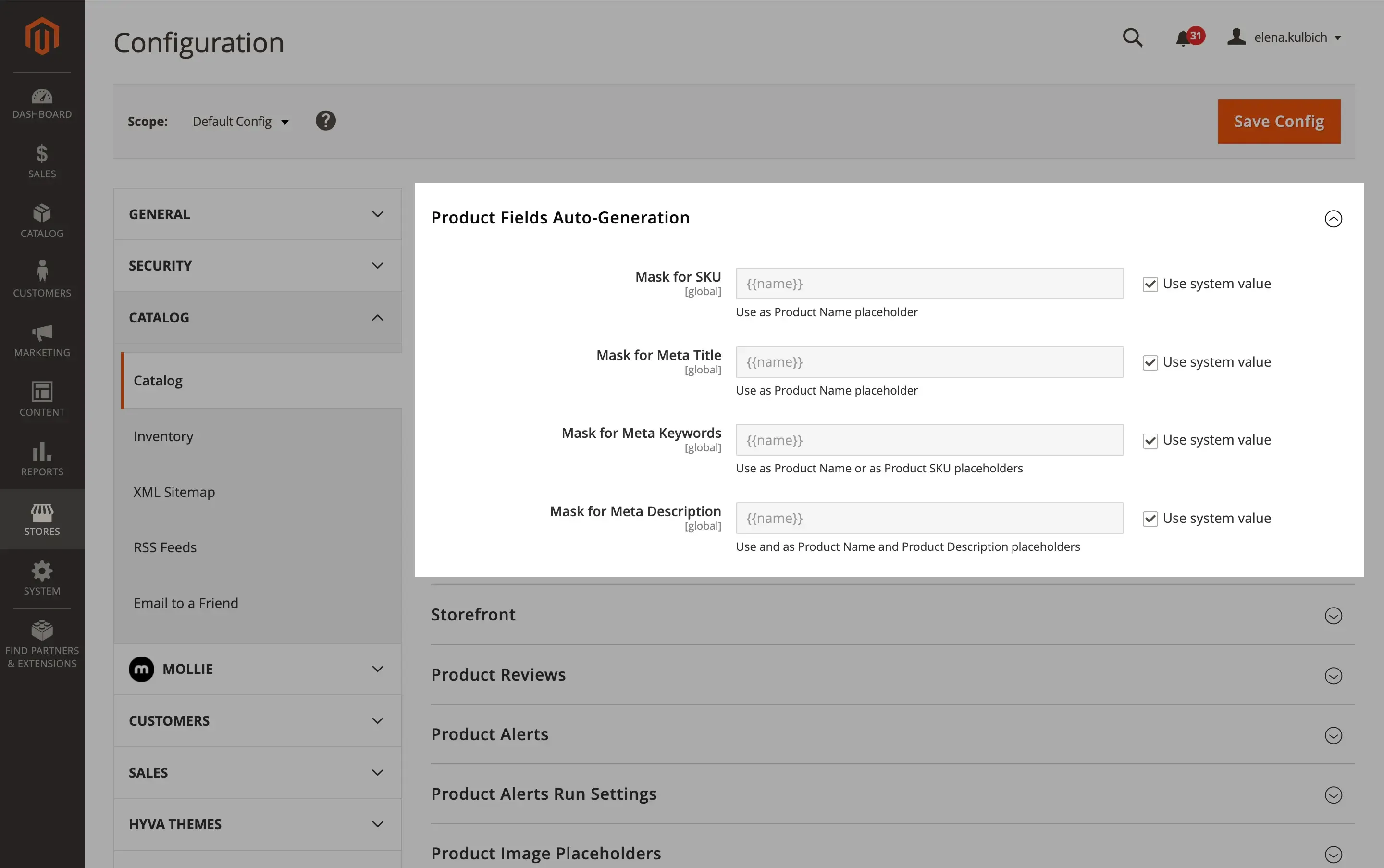
Magento's admin panel lets you manually set meta titles, descriptions, and URLs for every product, category, and CMS page. The Product Fields Auto-Generation feature allows global metadata templates using three placeholders: {{name}}, {{description}}, and {{sku}}. This is useful for large catalogs but offers limited flexibility for nuanced AI-optimized copy.
Stores > Configuration > Catalog > Product Fields Auto-Generation
Technical SEO Basics
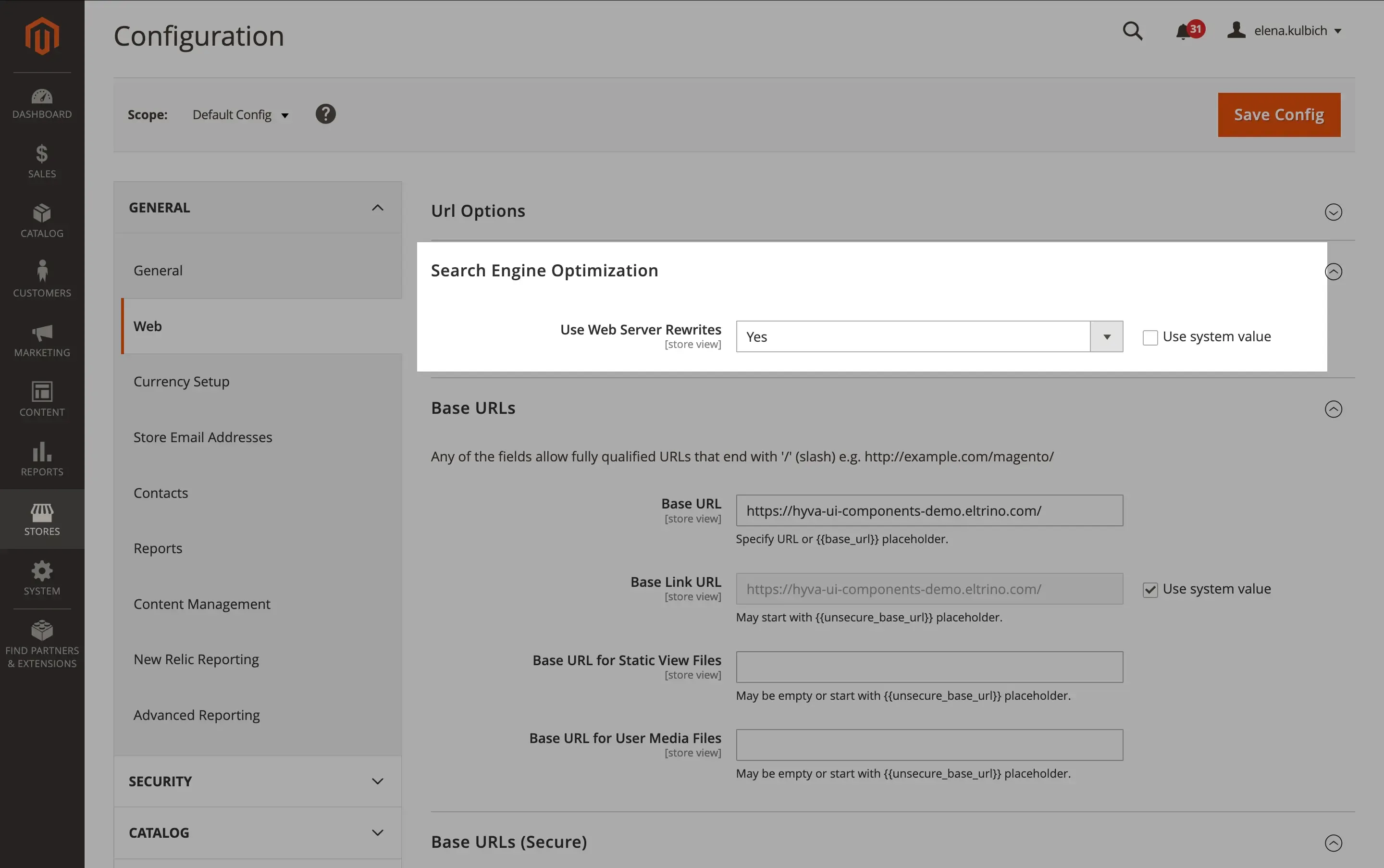
Out of the box, Magento supports SEO-friendly URL rewrites (eliminating "index.php" from URLs), canonical tags for products and categories to prevent duplicate content penalties, and an XML sitemap generator. These are non-negotiable foundations that Magento handles reliably.
Stores > Configuration > General> Web > Search Engine Optimization (Use Web Server Rewrites) > Yes
Indexing Control
Store admins can manage robots.txt directly from the admin panel and configure default meta robots tags (INDEX, FOLLOW or NOINDEX, NOFOLLOW). This control is essential for preventing AI crawlers from indexing thin or duplicate pages, though, as we'll cover later, it also requires updating to allow the new generation of AI bots.
Basic Structured Data
Magento includes simplified Microdata markup for product pages by default. However, it frequently omits essential attributes AI engines rely on most: brand, availability status, and review markup required for rich snippets and AI comparison tables. Mirasvit's rich snippets guide documents exactly which schema types are missing and how critical they are for modern search.
Performance & Analytics
While Magento lacks built-in image compression, it provides fields for image alt text and integrates natively with Google Analytics and Google Ads. Alt text is now a critical GEO signal, AI systems use image annotations as verification signals for content accuracy.
If you consider Hyva Commerce, image compression is included.
Key limitation: Magento's native structured data is "very simplified" and misses the exact attributes like brand, availability, reviews, that AI engines use to populate comparison tables and recommendation summaries. Third-party modules are not optional for competitive GEO visibility; they're mandatory.
Traditional SEO vs. AI Search. Understanding the Shift
To optimize effectively for 2026, Magento store owners must understand the fundamental differences between traditional SEO and AI visibility:
| Traditional SEO | AI Search (GEO) |
|---|---|
| Rank #1 on Google SERP | Be cited in AI-generated answer |
| Keyword density & backlinks | Semantic completeness & E-E-A-T |
| Click-through rate optimization | Information extraction & citation rate |
| Domain Authority (DA) | Entity clarity & factual trust |
| Long-form keyword pages | Self-contained 134–167 word answer islands |
| Text-only content | Multi-modal: text + image + video + schema |
Traditional Domain Authority is rapidly declining as an AI citation signal. Wellows' research on Google AI Overviews ranking factors found that nearly half of AI Overview citations now come from pages ranking below position #5 meaning well-structured content from newer or niche sites can consistently outperform high-DA incumbents.
The same shift is happening on your own site, not just in Google. Traditional keyword-based site search works like a brand-new trainee on their first day: a customer asks for something for a fancy dinner, and the trainee just searches for the word "fancy." AI-powered semantic search is your most seasoned store assistant, they hear "fancy dinner" and instantly understand context, surfacing cocktail dresses and elegant accessories. They solve the customer's need, not just their literal words. A customer can type "shoes that would match my red dress" and instead of a dead-end "no results found" page, they get sensible, relevant results.
This matters because the language of your customers and the language of AI are quickly becoming the same thing. They're both conversational. The brands that learn to speak this new language are the ones that get recommended, cited, and ultimately chosen.
The 7 Core Ranking Factors for AI Overviews
Based on current research into how Google's AI Overviews, ChatGPT, and Perplexity select content for citation, seven factors drive AI search visibility. Each maps directly to actions Magento store owners can take.
1. Semantic Completeness ("Answer Islands")
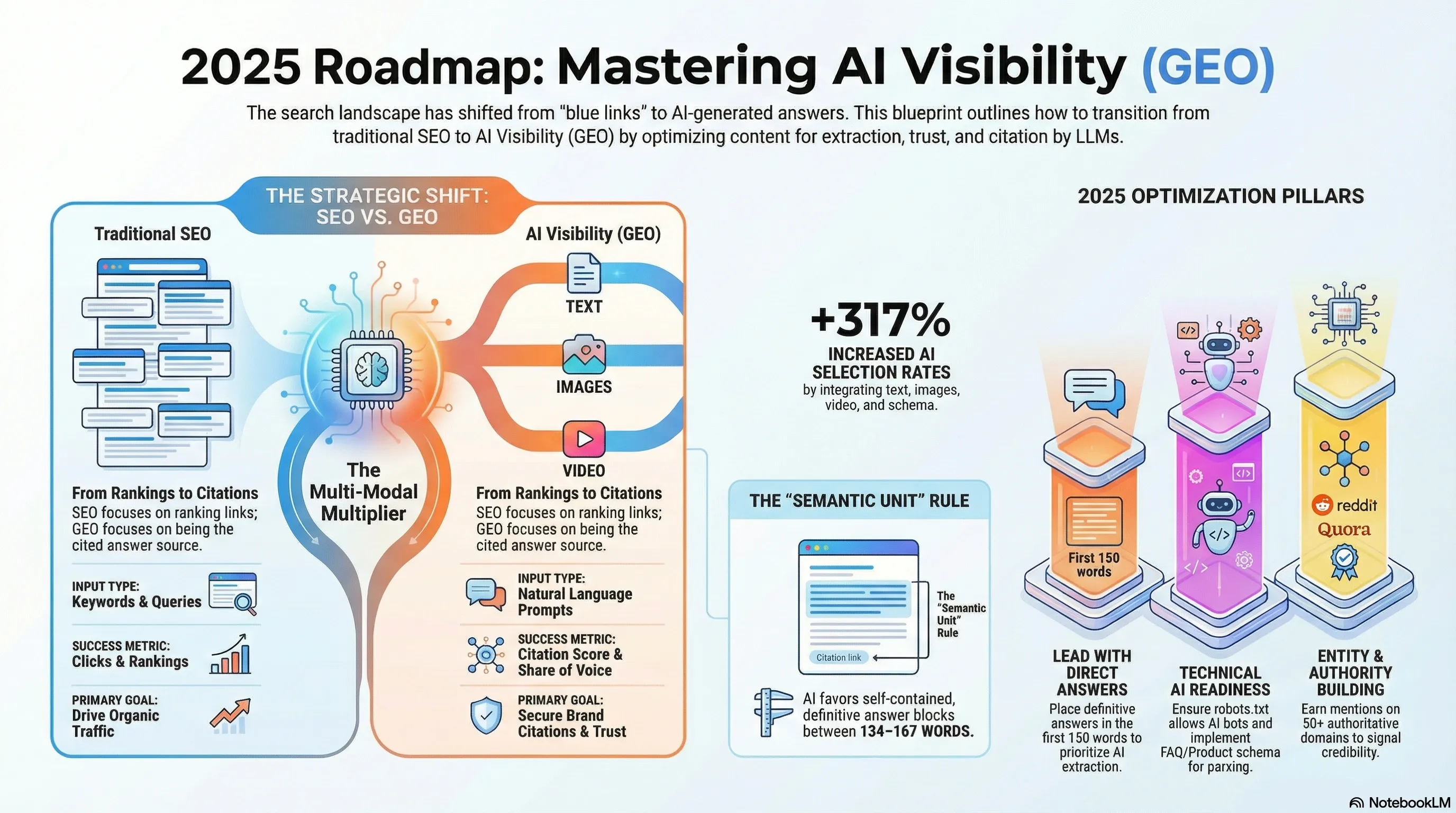
AI systems don't reward keyword density—they reward completeness. Rather than long pages stuffed with keyword variations, AI engines favor "answer islands": self-contained passages that fully address a question without requiring the user to click elsewhere.
The optimal passage length for AI extraction is 134–167 words. Product descriptions, category introductions, and FAQ answers written in this range—with the key answer appearing in the first 150 words—are significantly more likely to be cited in AI-generated responses.
- Action: Rewrite product descriptions and category pages to open with a direct, complete answer to the buyer's primary question.
- Action: Structure FAQ sections so each answer is self-contained and under 167 words.
2. Multi-Modal Content Integration
Text-only product pages have an AI citation rate of just 8.3%. Pages combining text, annotated images, short explainer videos, and structured data see up to a 317% increase in citation rates. AI systems interpret multi-modal content as higher-confidence information because the same fact is verified across multiple formats.
- Action: Every product detail page (PDP) should include descriptive alt text on all images, a short video or 360° view where relevant, and comparison data tables.
- Action: Use schema markup to connect your images and video content to the structured data layer.
3. Real-Time Factual Verification (E-E-A-T)
Google's AI cross-references claims against authoritative databases in real time. Content that includes verifiable statistics with primary source citations sees an 89% boost in AI selection probability. This makes E-E-A-T (Experience, Expertise, Authoritativeness, Trustworthiness) the most critical authority framework for GEO.
- Action: Add credentialed author bios to blog and guide content.
- Action: Replace unverifiable claims ("best quality") with specific, cited data points.
- Action: Ensure your brand NAP (Name, Address, Phone) is consistent across your site and all third-party directories to strengthen entity clarity.
4. Optimal Passage Length & Format
AI models are engineered to extract concise, structured answers. Beyond the 134–167 word passage rule, clear H2/H3 heading hierarchies, bullet points, and comparison tables dramatically increase extractability. Tables are especially powerful—AI engines frequently cite comparison content directly in their responses.
5. Entity Knowledge Graph Density
AI engines understand the web through entities—named things like brands, products, and people—rather than just keywords. The more clearly your brand and products are defined as entities within Google's Knowledge Graph, the more likely they are to appear in AI-generated answers. Consistent NAP data, Wikipedia presence, and linked social profiles all contribute to entity density.
6. Technical Accessibility for AI Crawlers
Many Magento stores are unintentionally blocking the very AI crawlers they need. Robots.txt files optimized for Googlebot often block GPTBot (ChatGPT), PerplexityBot, and Google-Extended (the crawler powering AI Overviews). Checking and correcting these permissions is a zero-cost, high-impact fix.
- Action: Update
robots.txtto explicitly allowGPTBot,PerplexityBot,ClaudeBot, andGoogle-Extended. - Action: Implement an
llms.txtfile—a machine-readable guidance document specifically for LLMs that signals which content to prioritize. - Action: Deploy IndexNow to notify search engines of catalog changes in real time.
7. Content Freshness
AI systems favor recently updated content, with pages updated in the last 30 days receiving significantly more citations than stale pages. For e-commerce stores with thousands of SKUs, automated freshness processes are essential. Regularly refreshing at least 10–15% of your content—particularly top-category pages and high-converting PDPs—maintains AI citation eligibility.
Wellows' AI visibility enhancement strategies guide covers freshness, topical clustering, and UGC signals in additional depth for e-commerce brands specifically.
Magento AI Search Optimization in Practice
With the ranking factors established, here is how to implement them across the five key optimization areas for a Magento store.
On-Site Content & Formatting
The shift to GEO requires a fundamental rewrite philosophy. Instead of writing for keyword density, write for question answering. Every product page should ask: "What is the most important question a buyer has about this product?" The answer should appear in the first 150 words of the page.
Use a conversational, natural tone that mirrors how users speak to AI assistants. "Is this jacket machine washable?" is a more effective opening question than a generic tagline. Structure page content with clear H2/H3 hierarchies that each address a distinct buyer intent, and add comparison tables wherever product specifications can be contrasted—these are among the most frequently cited content formats in AI answers.
Structured Data & Schema Markup
This is the single highest-leverage technical investment for Magento AI visibility. Structured data acts as a machine-readable layer that lets LLMs parse your content accurately. Research shows properly structured content has 73% higher AI selection rates than unstructured equivalents.
The mandatory JSON-LD schema types for Magento stores are: Product, Offer (price and availability), Review (with aggregateRating), FAQ, Organization, and BreadcrumbList. Magento's native Microdata handles none of these comprehensively. A dedicated schema module is effectively non-optional for competitive GEO visibility.
All images must include descriptive alt text matching the surrounding product content. Videos should include full transcripts—these serve as additional text layers that AI systems can parse and cite independently of the video itself.
Building E-E-A-T Authority
For Magento stores, E-E-A-T is built through a combination of on-site content and off-site signals. On-site, this means adding expert author attribution to buying guides and blog content, publishing original product data or research (material specifications, third-party test results), and featuring authentic customer reviews with structured markup.
Off-site, it means earning mentions and links from recognized publications in your vertical, maintaining consistent brand information across all directories, and ensuring your Google Business Profile is complete and verified. Together, these signals tell AI engines your store is a trustworthy authority, not just a transactional website.
Technical Readiness & Freshness
Beyond robots.txt and llms.txt, the key technical GEO lever is indexing speed. AI-powered search results—especially ChatGPT Search, which uses Bing's index—prioritize freshness. A product that updates its price or availability but doesn't notify search engines immediately may be cited with outdated information, or not cited at all.
Core Web Vitals also remain an indirect GEO factor: slow-loading pages create poor post-click experiences, which signals to AI systems that your site should be recommended less frequently. Image compression, code minification, and lazy loading should be baseline performance standards.
Post-Click Experience & the Pogo-Sticking Penalty
AI search engines monitor what happens after the click. If a user lands on your product page and immediately returns to the AI assistant because they couldn't find a shipping policy, size guide, or product specification, that negative signal reduces the likelihood of future AI recommendations—a pattern known as "pogo-sticking."
The most effective solution emerging in 2026 is on-site AI support agents. Tools like eesel AI connect to your Magento catalog, help documentation, and support ticket history to provide instant, 24/7 answers to customer questions. A shopper who gets an immediate answer to "What's your return policy?" stays on the page. A shopper who has to hunt for it does not. Webkul's guide to ranking Magento 2 on ChatGPT covers the technical post-click signals in further detail.
Magento Modules for SEO and AI Search optimization
Closing the gap between Magento's native capabilities and the demands of AI search requires a targeted stack of third-party modules. Here are the leading solutions mapped to each GEO requirement:
| Module | Purpose | Key Benefit for GEO |
|---|---|---|
| Mirasvit Advanced SEO Suite | Schema markup | Organization, FAQ, Review, Breadcrumb schema |
| Magmodules OpenAI Commerce | AI product feeds | JSON feeds with attribute mapping & cron automation |
| m2_feed_ai (olivertar) | AI product feeds | Open-source; supports large catalogs via chunking |
| m2_faqs_ai (olivertar) | FAQ / AEO | JSON-LD FAQs + product-specific support |
| Amasty Google Indexing API | Fast indexing | Notifies Google for faster AI Overview inclusion |
| Amasty SEO Toolkit Pro | Schema markup | Rich snippets: price, stock, ratings |
| Magmodules OpenAI Commerce | AI product feeds | JSON feeds with attribute mapping & cron automation |
Conclusion: Is Your Store Ready for the Agentic Web?
The trajectory of eCommerce search is clear. AI Overviews appear in over 60% of Google searches. Conversational AI assistants are becoming the primary discovery channel for a growing segment of shoppers. And the stores that will win citations and with them, traffic and revenue are those that have prepared their content and technical infrastructure for machines to read and trust.
For Magento store owners, this means moving beyond the native SEO toolkit. It means implementing comprehensive JSON-LD schema, structuring content as self-contained answer islands, building verifiable E-E-A-T authority, opening your site to AI crawlers, and delivering a post-click experience that gives users every reason to stay.