
Manufacturing

From components to complex systems, modern manufacturers need more than a digital catalog. Eltrino creates eCommerce platforms that unify product data, pricing, stock, and quoting across B2B, distributor, and D2C channels.
Manufacturing eCommerce Challenges
Manufacturers are undergoing a major shift: buyers - whether distributors, dealers, procurement teams, or end-customers now expect the same digital ease they get in retail. At the same time, more manufacturers are moving into D2C, adding another layer of complexity to already demanding B2B environments.
The challenge is not just putting a catalog online but delivering accurate product data, personalized pricing, real-time stock, and smooth buying workflows across multiple channels.
Manufacturers typically face challenges such as:
🧩 Complex product catalogs & configurations
Engineering-level product data, long BOMs, variants, accessories, replacements, CAD files, and technical documentation that must be searchable and understandable to both experts and non-experts.
🏭 Deep ERP + PIM integrations
Dynamic pricing, contract terms, stock levels, lead times, production status, and multi-warehouse inventory pulled in real time from ERP/PIM.
📦 D2C expansion without disrupting B2B
More manufacturers want to sell directly but must do it without cannibalizing distributors, breaking pricing structures, or recreating product data in multiple places.
💼 Advanced B2B workflows
Customer-specific pricing, quote and approval flows, budgets, purchase lists, role-based accounts, and tax/territory rules across multiple regions.
🌍 Globalisation & multi-market complexity
Multiple languages, currencies, assortments, regional compliance requirements, and dealer or subsidiary structures.
⚡ Performance & scalability
Large catalogs, logged-in heavy B2B traffic, and the need for fast search and filtering across thousands of SKUs and downloadable assets.
Manufacturers need platforms that handle industrial complexity while providing a consumer-grade experience whether selling to distributors, procurement teams, or directly to end customers.
Most Valuable Trends in Manufacturing eCommerce 2026
Manufacturers are entering one of the most transformative periods the industry has ever experienced. Buyers who once relied on phone calls, PDFs, and sales reps now expect fast, accurate, digital experiences and they’re willing to switch suppliers to get them. Research shows that 73% of buyers prefer online purchasing, 75% will move to a supplier with a better digital experience, and 98% of manufacturers already have or are actively building an eCommerce strategy. Yet despite this progress, one in three B2B orders still contains errors, pointing to a huge opportunity for improvement.
Digital-first sales become the new normal
By 2026, eCommerce is no longer a side channel. It becomes an operational core, the place where product data, pricing, lead times, documentation, and order history come together. Manufacturers are using digital platforms to streamline procurement, reduce manual entry, and provide real-time accuracy that phone or email ordering simply can’t match.
ERP-driven accuracy becomes the foundation
Manufacturing buyers expect real-time stock, production lead times, contract pricing, and reliable delivery information. This drives a major shift toward ERP-driven commerce, where ERP provides the source of truth and the eCommerce platform becomes the user-friendly experience layer.
Product data becomes a competitive advantage
Manufacturers handle incredibly complex catalogs: technical specifications, CAD files, materials, certifications, and regional variations. With 81% of buyers saying that product specs and guided selling tools are essential, the rapid adoption of PIM systems continues. Clean, structured product data is no longer a back-office task — it’s a differentiator.
Guided selling, configurators, and CPQ gain momentum
Manufacturing buyers often need help choosing the right product or configuration. This makes configurators, replacement-part finders, CPQ tools, and compatibility logic more important than ever. These tools reduce the burden on sales and engineering teams while giving buyers confidence in their decisions.
Reducing errors drives digital investment
Since 33% of online B2B orders still contain errors, manufacturers are prioritizing automation, ERP/PIM integration, and UX improvements that reduce mistakes and cut operational costs. Reliable data and intuitive digital journeys are becoming essential for customer retention.
Related Case Studies
Southco
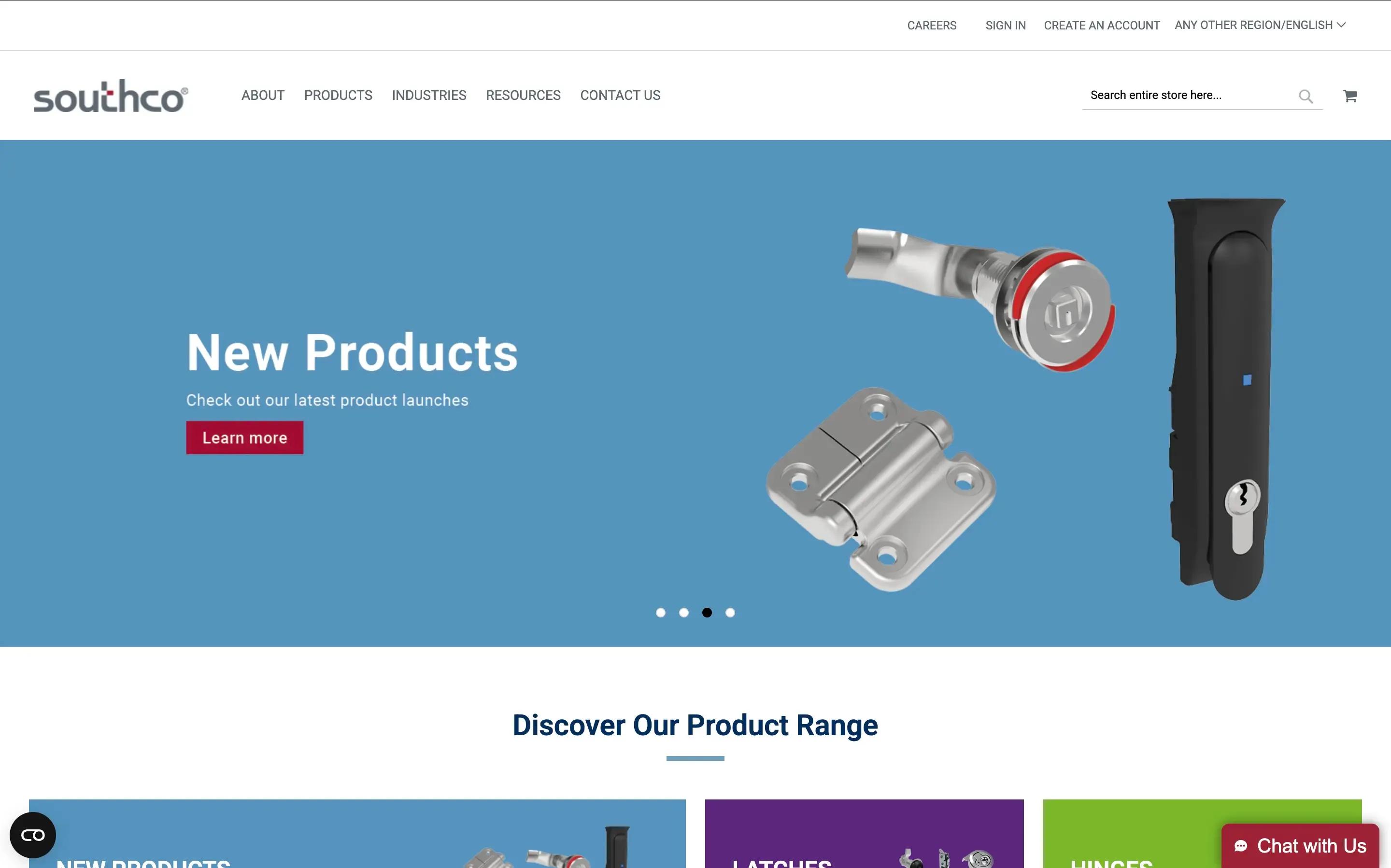
Southco, a global manufacturer with 100,000+ customers in 83 countries, with 17 manufacturing sites across 9 countries, needed more than a catalog, they needed a scalable Magento 2 solution built for multi-store, multi-warehouse, and ERP-driven commerce. We delivered a future-ready platform with custom integrations, localized storefronts, and ongoing support - ideal for global B2B and manufacturing leaders.

Engels
Engels Group - a 70-year-old Dutch family business with a €40M annual turnover, specializes in sustainable logistic solutions. As they prepared to expand into the UK market, they needed a modern, high-performing eCommerce platform to support their B2B and B2C growth. We developed a cohesive design system, a brand-new frontend with a Hyva theme, and enhanced functionality.
Content
Related Case Studies
Southco
Southco, a global manufacturer with 100,000+ customers in 83 countries, with 17 manufacturing sites across 9 countries, needed more than a catalog, they needed a scalable Magento 2 solution built for multi-store, multi-warehouse, and ERP-driven commerce. We delivered a future-ready platform with custom integrations, localized storefronts, and ongoing support - ideal for global B2B and manufacturing leaders.
Engels
Engels Group - a 70-year-old Dutch family business with a €40M annual turnover, specializes in sustainable logistic solutions. As they prepared to expand into the UK market, they needed a modern, high-performing eCommerce platform to support their B2B and B2C growth. We developed a cohesive design system, a brand-new frontend with a Hyva theme, and enhanced functionality.