
Kontakt
Magento performance optimization for the Caucasus region's #1 consumer electronics retailer. 5–6x faster pages, reindex from 60 minutes to 7.
Feb 2024 - currently
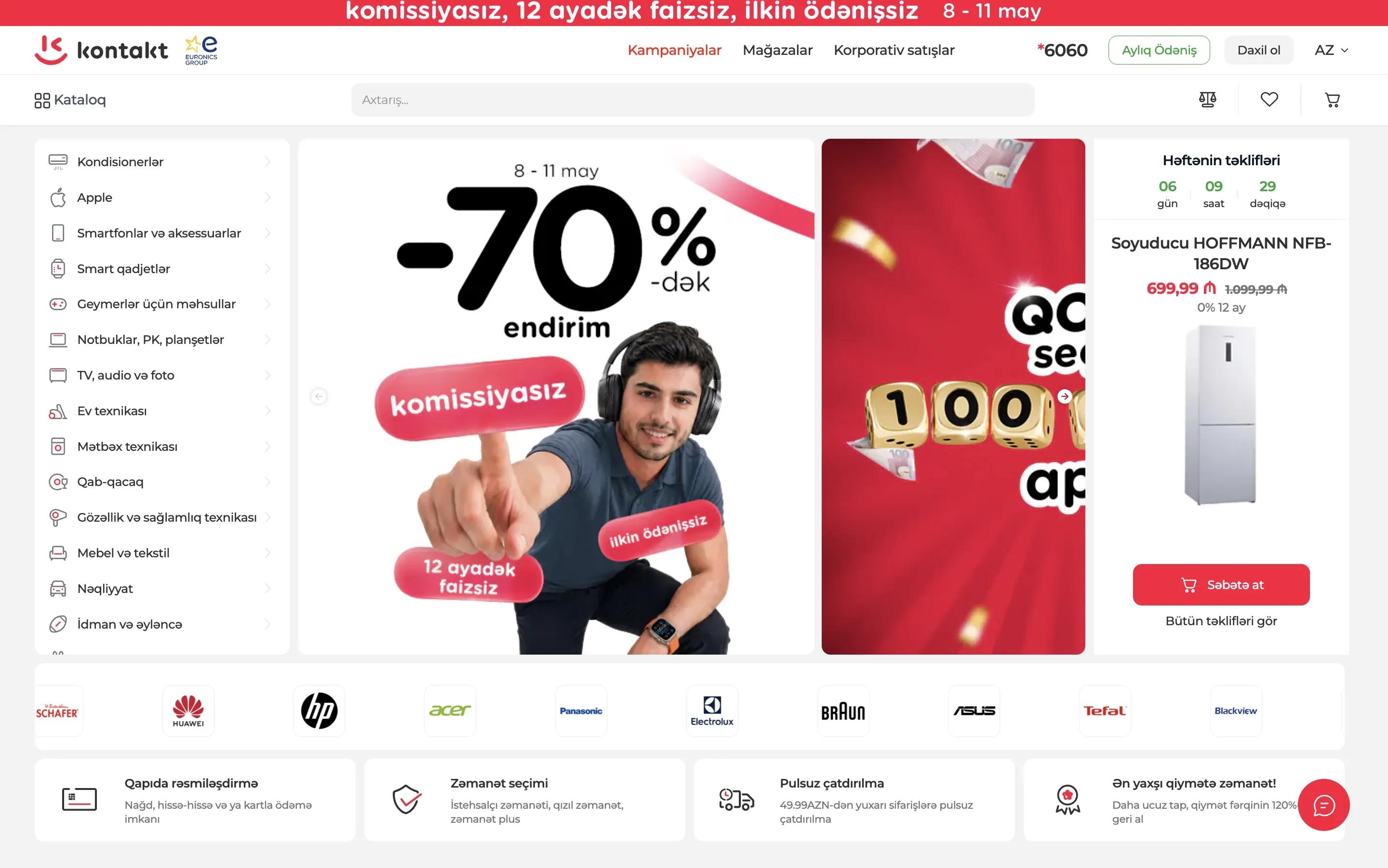
How Eltrino partnered with Kontakt.az and Kontakt.ge, the Caucasus Region's Retail Leader, to rebuild their Magento foundation for speed, stability, and a headless future.
5–6x faster pages
across both stores
0.5–0.7s page response
with a warm cache
Kontakt is the leading consumer electronics, home appliances, and furniture retailer in the Caucasus — with 50+ stores across Azerbaijan, 4 in Georgia, and partnerships with more than 100 international brands. The Kontakt team was looking for a new eCommerce partner with experience building stores for market leaders and the technical depth to help them keep growing. We started with a code audit, optimised the foundation, and continue to work alongside the Kontakt team as their platform evolves.
About the project
Kontakt runs the largest eCommerce platform in the Caucasus region. The brand brings consumer electronics, home appliances, furniture, and home accessories under one roof — with over 50 stores in Azerbaijan, four stores in Georgia, and long-standing partnerships with more than 100 international brands.
The scale of that leadership is visible in the traffic data. In March 2026, kontakt.az drew 2 million monthly visits, ranking #17 nationally across all websites in Azerbaijan and more than 2x ahead of its nearest direct competitor in the electronics retail segment (SimilarWeb). The audience is overwhelmingly mobile (86.82%), with organic search driving 43.49% of traffic and direct visits another 20.85% — strong signals of brand recognition and a customer base that comes back.
Being the leader is harder than being the challenger. The leader sets the bar — on assortment, pricing, speed, availability — and every competitor's strategy is built around closing the gap. Holding that position takes disproportionate, sustained investment in catalogue depth, infrastructure, and customer experience. There's no coasting at the top.
The company runs two distinct eCommerce properties — kontakt.az for the Azerbaijani market and kontakt.ge for Georgia. While the product categories overlap, the two markets are not interchangeable. Kontakt Home's CEO Radik Asgarli, who led the brand's 2021 entry into Georgia, has been open about this in Forbes Georgia — noting that "Azerbaijan and Georgia differ significantly in culture and business style," and that Kontakt Home deliberately chose not to replicate the Azerbaijani model in Georgia. The Georgian operation built its own playbook from team structure to commercial offer, including in-house, no-bank-required installment plans that differentiate kontakt.ge in its local market.
That commercial reality is reflected technically. Kontakt.az and kontakt.ge are run as fully independent projects: separate Magento installations, separate infrastructure, separate management. Around 75,000 products are managed on Kontakt.az, with another 15,000 on Kontakt.ge.
Both stores run on Magento Open Source with monolith architecture.
The Challenge
Kontakt's brief was to find a partner that could match the operational tempo of a market leader and bring the technical foundation up to where it needed to be for the next phase of growth. The codebase had drifted out of sync with current Magento versions over time. There were also a lot of installed modules and more code from different providers means more surface area for conflicts, harder upgrades, and slower releases. Several commercial extensions duplicated functionality that newer Magento versions handle natively.
For a market leader processing hundreds of orders a day, most of them coming from a mobile audience and discovered through organic search this had real consequences:
- Page load times were slow, hurting conversion, user experience, and SEO
- Product imports were taking hours, blocking timely catalogue updates
- Reindexing was a 40–60 minute operation during which the store couldn't reliably serve fresh content, which is again, poor user experience
- Database deadlocks during imports caused frequent failures, requiring manual intervention
- Module sprawl made the codebase harder to extend safely, with each change carrying the risk of conflicts between extensions
The brief was clear: take over the technical side, bring the store up to where it should be performance-wise, and prepare a clean foundation for the next chapter - a new storefront.
What we've done
Code audit first
Before touching anything, we ran a full Magento code audit. This gave us and the client a shared, honest picture of the codebase: which modules were stable, which were redundant, where technical debt was concentrated, and where the biggest wins were. Every optimisation that followed came from this audit.
Module cleanup and version alignment
We brought every Magento module up to a current, supported version, and removed paid extensions where Magento's default functionality covered the same need. This wasn't a cost-cutting exercise — it was a stability decision. Each commercial module is another upgrade dependency, another support contract, and another potential point of failure on Black Friday. Where the default Magento behaviour was good enough, we used it.
Performance optimisation across the stack
We rebuilt the layers of the application that determined how fast a page is delivered:
- With a warm cache, product and category pages are now served in 0.5–0.7 seconds
- With a cold cache, depending on the page, response times sit at 2–5 seconds — a level we expect to push down further as work continues
- Across both stores, page response times improved by 5–6x versus where we started
Reindex optimisation
Reindex time dropped from 40–60 minutes to around 7 minutes. For a 75,000-SKU catalogue with frequent price and stock changes, this is the difference between a store that reflects reality and one that lags behind it.
Product and price import optimisation
Imports — downloading the source file, parsing, validating, importing, reindexing — were rebuilt using Magento's default import mechanism with targeted optimisations:
- Product import: from 2 hours to 1 hour for full catalogue updates
- Price import: from 30 minutes to 15 minutes
- Custom retry system built on top of the default importer to handle the database deadlocks that were a recurring problem (the database is under heavy concurrent load — we treat occasional deadlocks as expected and recover from them automatically rather than failing the entire import)
Multi-source search
Customers don't just search for products. They search for categories, for brand names, for help-centre articles, for promotional landing pages. Kontakt now runs a multi-source search architecture that returns matches across all of these in a single result set — products, categories, CMS pages, suggestions — with the relevance and ranking tuned to how Kontakt's customers actually shop.
The next chapter: a headless storefront
With the foundation stable and the catalogue and import layers operating on time, Kontakt is moving on to the next chapter — a headless storefront. The optimisation work to date was a prerequisite: the new architecture needs a clean, fast Magento backend underneath it. We're now working with the Kontakt team on that build across both .az and .ge.
Process improvements
Beyond code, we tightened how the work itself is done — task structure, development workflow, testing, release processes. For a store of Kontakt's size and complexity, predictable delivery matters as much as raw engineering output.
Results
The headline numbers from the takeover and optimisation phase:
| Metric | Before | After |
|---|---|---|
| Page response time (warm cache) | 3–4s | 0.5–0.7s |
| Page response time (cold cache) | 10s+ | 2–5s |
| Reindex time | 40–60 min | ~7 min |
| Product import (full catalogue, ~75k SKUs) | 2 hours | 1 hour |
| Price import | 30 min | 15 min |
| Import reliability | Frequent manual retries needed | Automatic retry on deadlocks |
Order volume itself isn't the right way to measure this kind of work. Kontakt is the dominant retailer in its market — there isn't a 5x growth opportunity hiding in a faster page load. What faster pages, cleaner imports, and reliable reindexing buy a market leader is something else: stability under pressure (Black Friday, payday weekends, new product launches), operational efficiency (catalogue updates that happen on time, not when imports finally finish), and headroom for what comes next (a headless storefront needs a clean, fast backend underneath it — that foundation is now in place).