
Olivia
Olivia Beauty & Care has done in four years what most retailers take fifteen. From a 2022 launch to a 50-store network and a Magento-powered online flagship serving one of the largest beauty audiences in Azerbaijan.
Sep 2024 - currently
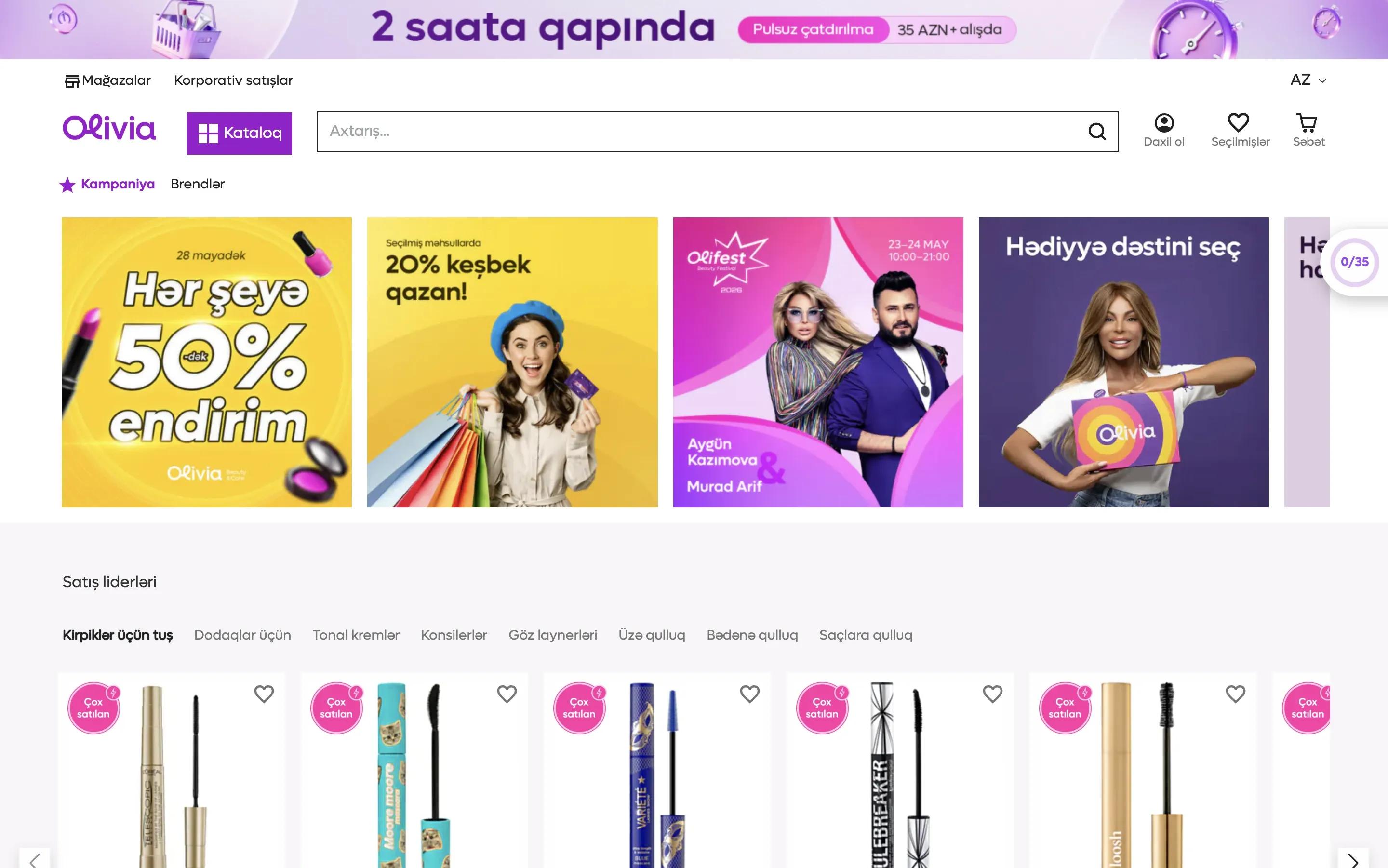
Scaling the Magento Foundation Behind Olivia - Azerbaijan's Beauty Brand
About the project
Olivia Beauty & Care launched in 2022 as a multi-brand beauty retail chain — and grew, fast. Within four years the brand had built a network of more than 50 physical stores across Azerbaijan and an online flagship at olivia.az carrying an international assortment from Turkey, Italy, Poland, Korea, England, and beyond.
The audience around the brand grew at a similar pace. Olivia's Instagram community alone now sits at more than 327,000 followers — a number that, set against the brand's four-year history, says something specific about how this business works. Olivia's customers don't come to the store because they always have. They come because they discovered the brand on their phone, watched a launch announcement on a reel, and decided to follow through.
That has consequences for what the website is actually for. A beauty multi-brand store is not a steady-state catalogue. New brands arrive on the floor every few weeks. Existing brands drop new collections with new shades, new sizes, new packaging. Promotions move quickly, often coordinated with a social post that already has thousands of views by the time customers land on a category page. The product catalogue and the storefront have to keep up with all of that — at scale, on mobile, without slowing down.
The store runs on Magento Open Source with a monolith architecture.
The Challange
The challenge Olivia brought us was not the one we had seen at older Magento stores. There was no decade of accumulated technical debt to peel back. The store was new. The catalogue was newer. What had been built worked, more or less — until the pace at which Olivia kept adding to it started to outrun the foundation it was sitting on.
That's the kind of problem fast-growing brands tend to discover all at once. A platform that performs well at launch starts to feel slower as the catalogue grows. Reindexing that took a few minutes at five thousand products takes considerably longer at several times that. Imports that finished quickly when a single supplier's feed was loaded become longer operations as more brands come on board. The architecture didn't change; the business around it did. And at some point the gap stops being something the team can absorb.
By the time we came in, the symptoms were specific:
- Catalogue pages were slower than they needed to be for a mobile-first, social-driven audience
- Reindexing — running every time prices or stock changed — was holding up fresh content for too long
- Product imports were taking hours and sometimes failing partway through on database deadlocks
- A growing surface of installed modules was making safe upgrades harder and increasing the risk of conflicts between extensions What Olivia's team wanted was something simple to describe and not always simple to deliver: a foundation sized to the brand the company has actually become, rather than the one it was when the store first launched.
What we did
The work itself looked very similar to the engineering work we have done for other high-traffic Magento stores in this market. The recipe is well-tested. What's different on a project like Olivia is which of those steps matters most for the brand in front of you.
Reading the codebase first
We started with a Magento code audit before changing anything in production. The audit is what tells us which modules are doing real work, which are duplicating native Magento functionality, where technical debt is concentrated, and which of the visible performance symptoms have a single common cause underneath them. Everything that followed traced back to a finding in that document.
Lightening the load
For Olivia, the most consequential structural change was the same one it usually is: trimming the module footprint. Paid extensions came out where the native Magento behaviour was good enough. Remaining modules were brought up to current, supported versions. The dependency graph got noticeably simpler — and with that, releases got faster, upgrades got safer, and the surface area for conflicts shrank.
Speed where customers feel it
We rebuilt the layers of the application that determine how quickly a page reaches the browser. The result was a 5–6x improvement in page response times, with product and category pages now rendering in 0.5–0.7 seconds with a warm cache. For a brand whose customers arrive from a social feed and expect the site to behave like the feed did — instantly — that's the difference that matters.
A catalogue that keeps up with the brand
Olivia's catalogue moves fast: new brands, new collections, shade and variant updates, promotional pricing tied to social activity. Two operational layers had to be able to keep that pace.
Reindexing dropped from a 40–60 minute operation to about 7. New prices and stock changes now show up across the store in minutes, not the better part of an hour.
Product and price imports were rebuilt on top of Magento's standard importer, with a custom retry layer that handles the database deadlocks that used to bring imports down mid-run. The store recovers from contention automatically, instead of waiting for someone to log in and restart the job. Product import time was cut roughly in half; price imports came down by the same proportion.
A search that works the way customers do
Olivia's shoppers search for brands by name. They search for ingredients. They search for the exact product they saw on Instagram twenty minutes ago. We moved the store onto a multi-source search architecture that returns matches across product names, brands, categories, and CMS pages in a single result set — with relevance tuned to how this specific catalogue is actually browsed.
Tightening the workflow around the code
For a business adding products and brands as fast as Olivia does, the process around the development work matters as much as the work itself. Task structure, release cadence, testing — all of it got tightened so that the technical debt we had just cleared doesn't quietly start rebuilding.
Results
What does this mean for a brand at Olivia's stage? A few things. A customer arriving from a reel finds a site that loads at the speed they expect. A merchandiser publishes a new collection and sees it live across the store within minutes rather than an hour. A marketing team running a flash promotion doesn't have to time it around when the next reindex window happens to be open. None of that shows up as a single headline metric. All of it shows up in how the brand actually operates day to day.