
Your next customer is an AI agent. Are you ready for Agentic Commerce?
26.03.2026

Shoppers are delegating to AI. Agentic Commerce is here: customers compare and buy directly in chat. See what it is, why it matters, and how Shopify/Magento merchants can prepare with GEO/GXO to stay visible, trusted, and chosen.
The Shift Is Here: Users, Traffic, and AI Shopping
The shift from browsing to delegating is accelerating — and it is happening across every major AI platform simultaneously. Shoppers are asking ChatGPT, Gemini, Microsoft Copilot, and Perplexity to find, compare, and buy products on their behalf. Adobe Analytics reported a roughly 1,200% year-over-year surge in generative AI referral traffic to U.S. retail sites in early 2025 — and by mid-2025 that number had ballooned to approximately 4,700% YoY. The latest Adobe Digital Insights Report (January 2026) shows that shoppers arriving via AI referrals now convert 31% higher, generate 254% more revenue per visit, and spend 45% more time on-site than traditional traffic.
And these AI platforms are not just sending traffic — they are becoming shopping channels in their own right:
- ChatGPT launched "Buy it in ChatGPT" with Stripe-powered Instant Checkout, letting shoppers complete purchases without leaving the conversation. OpenAI and Stripe co-developed the Agentic Commerce Protocol (ACP) to power this flow, with early adopters including Etsy, URBN, Coach, and Revolve.
- Google unveiled the Universal Commerce Protocol (UCP) at NRF 2026, co-developed with Shopify and backed by over 20 partners including Visa, Mastercard, Target, Walmart, and Zalando. Agentic checkout is rolling out in AI Mode in Google Search and in the Gemini app.
- Microsoft Copilot now supports embedded checkout for Shopify merchants, with Mastercard's Agent Pay providing the payment authorization layer.
- Perplexity expanded its Buy with Pro in-chat checkout to all users via a PayPal partnership, connecting to over 5,000 merchants.
- Amazon launched "Buy for Me," enabling purchases from third-party retailers without leaving the Amazon app, and expanded coverage to over 500,000 products.
- Meta acquired general-purpose agent developer Manus in December 2025 and teased agentic shopping tools for its advertiser catalog during its January 2026 earnings call, with $115–135 billion earmarked for AI infrastructure.
Agentic commerce is no longer a concept — it is a live, multi-platform channel. The question for merchants is no longer if but how fast they can prepare their stores.
Consumers are moving from "search → click" to "ask → buy in chat." Instead of opening tabs, they ask an AI to research, compare, and now even complete the order in the same conversation.
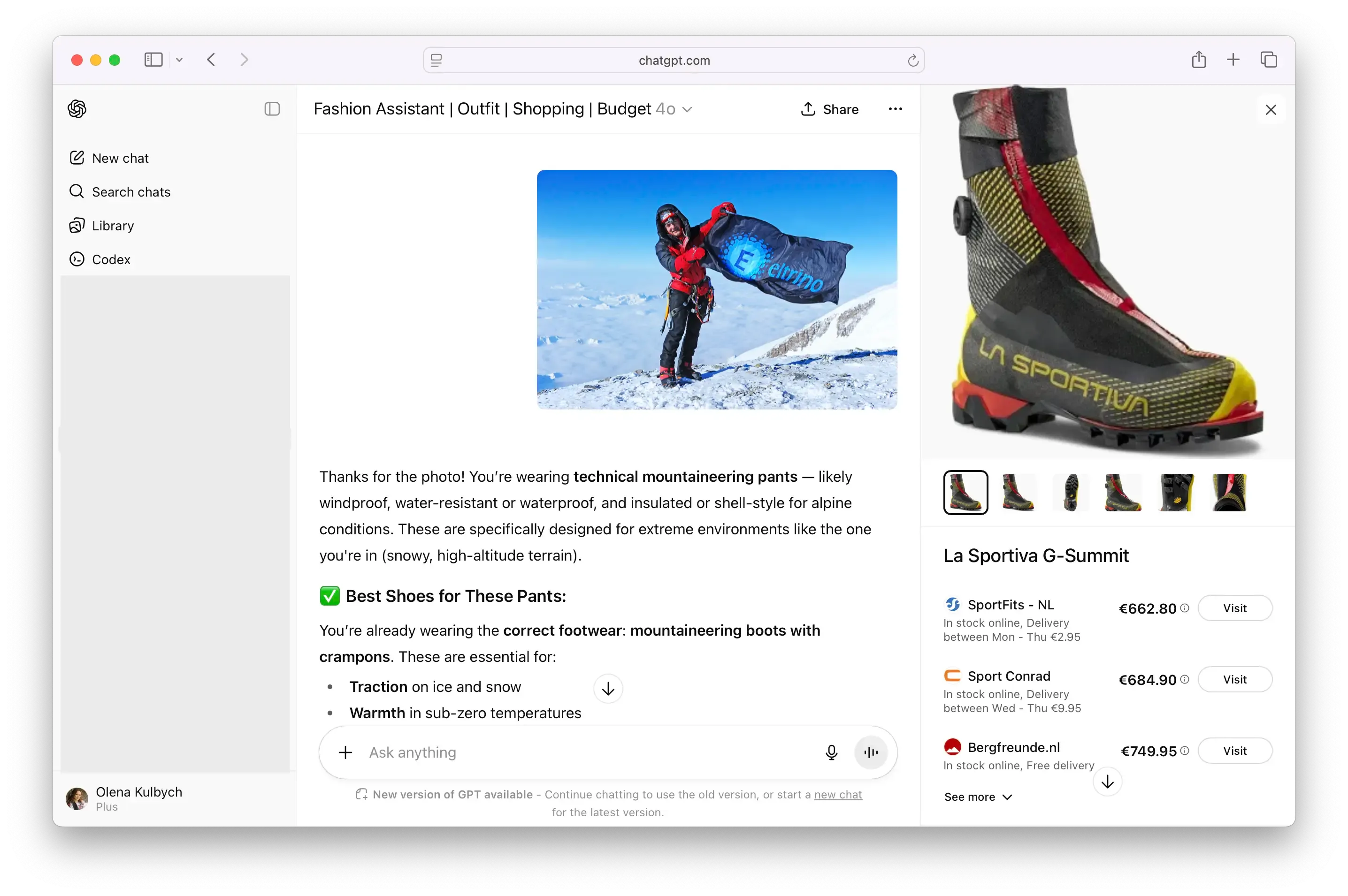
With Buy it in ChatGPT, shoppers get Instant Checkout — tap "Buy," confirm shipping and payment, done without leaving chat. (Currently just in the US but a global spread is just a question of time.)
Just one request and ChatGPT provides you with several product recommendations, stock availability, delivery prices, why you would like, what people are saying, and summarized reviews from different resources (Trustpilot, Etsy, Medium, Amazon, and others). From the user's perspective, it sounds like a dream — it saves so much time and effort, doesn't it?
▶ Watch ChatGPT Shopping in action
How US customers use generative AI for shopping
According to a survey conducted by Adobe involving 5,000 U.S. consumers, 38% reported having used generative AI for online shopping, and 52% plan to do so within the year. The various shopping tasks that consumers utilize AI for include conducting research (53% of respondents), receiving product recommendations (40%), searching for deals (36%), creating shopping lists (30%), finding gift ideas (30%), discovering unique products (29%), and utilizing virtual try-on features (26%).

What is Agentic Commerce (in plain language)?
Agentic commerce is when AI agents autonomously discover, evaluate, and purchase products on behalf of users and then hand off to your systems for fulfilment and support. So instead of a person clicking around your site, an AI agent (e.g., ChatGPT/Copilot/Gemini) does the shopping for them. The agent understands the request, compares options, and can even place the order inside the chat. Your store still ships the order and handles returns, nothing changes there.
What actually happens:
- A shopper tells an agent what they want ("running shoes under €120, wide fit, next-day delivery").
- The agent checks multiple stores, compares price, stock, delivery, and reviews.
- It recommends the best option(s) and, if approved, buys, very often without opening your webshop.
- Your Magento/Shopify store receives the order, takes payment, ships, and supports the customer as usual.
How this differs from classic eCommerce:
- Where discovery happens: not only in Google or your nav (on-site search, catalog, filters, etc), but inside AI chats.
- Who does the comparison: not the shopper in 10 tabs, but the agent does it for them.
- Where checkout happens: increasingly in the chat (the agent's surface), not just on your checkout page.
- What you must optimize: less for keywords and banners, more for clean product data, clear policies, and reliable APIs agents can read and trust.
Bridge (why the funnel feels different):
- Classic funnel: Search → Category → Product page → Cart → Checkout
- Agentic funnel: Prompt → Compare → Buy (then your systems Fulfil → Support)
The steps inside the chat replace many clicks on your site. That's why data quality and machine-readable info matter more than ever.
Trust is everything. Agents will choose the store they can understand and trust. That means:
- Clear, structured product data (titles, attributes, sizes, SKU, images).
- Up-to-date availability, price, delivery times, and returns policy.
- Strong reviews/SLAs and low cancellation/return friction. (Reviews not only on your website but on other platforms.)
There's an open standard called the Agentic Commerce Protocol (ACP) that lets agents and stores "speak the same language" to create carts, take payment, and manage order status. You remain the merchant of record; your payment processor, fulfilment, and support all still run on your side. (Think of ACP as a tidy connector so the agent can check out smoothly.)
If your data is clear, your policies are visible, and your systems are stable, agents will recommend (and buy from) you more often, bringing you orders even when the shopper never visits your homepage.
As a merchant, you'll lose some control you had on your webshop: agents own the first impression, comparison framing, and even the checkout surface, so your brand story can get compressed to specs, price, and delivery. That raises real risks: race-to-the-bottom pricing, ranking opacity (why an agent chose a rival), margin squeeze, lost attribution, bad data cascades (stale price/stock → canceled orders), more returns, fraud vectors, and platform dependency on a few agent ecosystems.
The upside: if you step in early, you can shape how agents read your catalog, build GEO/GXO advantages, win preferred placement, and lock in trust signals (reviews, SLAs, low latency) that compound over time, so you're chosen for value, not just the lowest price.
What does Agentic Commerce Mean for Merchants and Retailers
Discoverability shift. Agents parse context and intent, not just keywords. A prompt like "eco hoodie under €60, ships this week" becomes entity-level matching across attributes, stock, delivery promises, and reviews. If your data is thin or stale, you're invisible.
Competition shift. Instead of fighting for clicks and ad slots, you're competing on data quality and agent visibility: clean specs, reliable availability, clear policies, fast responses via APIs/webhooks. Agents prefer merchants they can understand and trust at machine speed.
Personalization leap. Agents optimize to the buyer's constraints like price tolerance, delivery speed, fit/size, sustainability, warranty, returns friction, and will auto-prefer merchants whose data matches those preferences consistently.
What this changes for Magento/Shopify teams (quick wins):
- Enrich product data: titles, attributes, SKU, images with alt text, sizing/fit, materials, care.
- Expose freshness: live price/stock, cut-off times, delivery SLAs, returns window, warranty terms.
- Strengthen trust: verified reviews, star ratings, store policies in structured form.
- Tighten ops signals: low cancel/return rates, on-time fulfilment, clear RMA steps — surface these.
Signals that make agents choose you
- Specs & attributes (complete, standardized)
- Availability & price (live, consistent)
- Delivery promise (speed, cut-off, cost)
- Returns & warranty (clear, low friction)
- Reviews & reliability (ratings, SLA performance)
- Policy clarity (tax, duties, sustainability claims)
Agentic surfaces reward merchants who are machine-readable, trustworthy, and fast. Invest in data quality and operational signals now to be chosen more often.
Businesses from what you can shop directly within ChatGPT
Live now (U.S.)
Etsy sellers — you can buy eligible Etsy items directly in ChatGPT via Instant Checkout. U.S. ChatGPT Plus, Pro, and Free users can now buy directly from U.S. Etsy sellers right in chat.
Rolling out
Walmart & Sam's Club — Walmart announced in-chat shopping in ChatGPT using Instant Checkout. Walmart and Sam's Club customers can buy directly inside ChatGPT with Instant Checkout, plan meals or restock essentials in chat, then confirm shipping and payment in one flow. It's part of Walmart's broader AI-first push (learning, planning, predicting) that builds on existing AI for catalog enrichment and customer care.
Coming soon
With ChatGPT instant checkout, Shopify merchants (e.g., Glossier, SKIMS, Spanx, Vuori) will soon be able to sell their products via ChatGPT.
It’s Not Just ChatGPT shopping
Multiple AI surfaces are becoming shopping entry points, so you're optimizing for more than one "assistant":
- Microsoft Copilot. Microsoft launched the Copilot Merchant Program so brands can feed catalogs/specs to Copilot and surface products (with pricing and purchase options) inside Copilot experiences.
- Google Gemini / AI Mode in Search. Google is adding AI Mode to Smart Shopping; Gemini + the Shopping Graph (50B+ listings) help users describe what they want conversationally and refine to buyable options.
- Perplexity. Perplexity Buy like a Pro recommends products with sources and buy paths; it has piloted merchant programs and native purchase experiences that collapse research and checkout.
The protocol layer: how agents and stores talk to each other
Behind all of these AI shopping surfaces, an infrastructure layer has formed — open standards that let agents and merchants communicate securely, regardless of which AI platform the shopper uses.
Agentic Commerce Protocol (ACP) was co-developed by OpenAI and Stripe. It defines how AI agents discover products, initiate checkouts, and complete purchases. ACP powers "Buy it in ChatGPT" and Stripe's Agentic Commerce Suite, which launched in December 2025 and is already rolling out via Wix, WooCommerce, BigCommerce, Squarespace, commercetools, and Akeneo. Early adopters include URBN (Anthropologie, Free People, Urban Outfitters), Etsy, Coach, Kate Spade, and Revolve.
Universal Commerce Protocol (UCP) was co-developed by Google and Shopify and unveiled at NRF 2026 in January. Where ACP focuses on agent-to-merchant transactions, UCP covers the full shopping journey — from product discovery through checkout to post-purchase support (returns, refunds, order tracking). It has been endorsed by over 20 partners including Visa, Mastercard, Stripe, American Express, Target, Walmart, Wayfair, Etsy, Best Buy, Macy's, Home Depot, and Zalando.
Payment rails are going agentic too. Visa launched its Intelligent Commerce platform with 100+ partners, completed hundreds of agent-initiated transactions in December 2025, and predicts millions by holiday 2026. Mastercard rolled out Agent Pay to all U.S. cardholders and joined Google's UCP. PayPal adopted ACP to expand merchant coverage in ChatGPT.
These protocols are more complementary than competing — ACP handles the checkout mechanics, UCP covers the full journey, and the payment rails connect to both. As a merchant, you do not need to choose one; you need your data and APIs to be clean enough that any protocol can work with them.
What Shopify merchants can do to get the maximum from Agentic Commerce
If you're on Shopify, congrats, you basically pulled the lucky ticket. Just sit and enjoy 😁 If you're a Shopify merchant (US based), you do not need to apply or build an integration for Instant Checkout — you are already eligible. But it's only about Instant Checkout in ChatGPT, Agentic Commerce is much wider and you can always do better, so there are things to do.
Shopify Agentic Storefronts: your store is already in AI chats
Shopify has made a major move. In its Winter '26 Edition (December 2025), Shopify launched Agentic Storefronts — a built-in sales channel that connects your product catalog directly to ChatGPT, Google AI Mode, Gemini, Microsoft Copilot, and Perplexity. One setup in your Shopify Admin and your products become discoverable and purchasable inside AI conversations across all supported platforms.
As of late March 2026, Shopify is activating Agentic Storefronts by default for all stores. If you have not opted out, your products are already appearing in ChatGPT responses right now.
How it works under the hood:
The system runs on two layers. Shopify Catalog uses specialized LLMs to categorize, standardize, and enrich your product data automatically — translating your catalog into something AI agents can parse, compare, and present with accurate pricing and availability. And the Universal Commerce Protocol (UCP), co-developed by Shopify and Google, provides the open standard that handles the full transaction flow.
You remain the merchant of record. Your payment processor, fulfillment, and customer relationships stay yours. Orders flow into your Shopify Admin attributed to the specific AI channel they came from.
Check your settings. Go to Settings → Apps and sales channels in your Shopify Admin and look for the Agentic storefronts section. You can toggle individual AI channels on or off, and choose whether customers complete purchases in-chat or get redirected to your online store. Shopify's Help Center has the full setup walkthrough.
Use Catalog Mapping. If you have custom product data in metafields, metaobjects, or tag prefixes, use Shopify's Catalog Mapping feature so the system understands your data structure.
Know the fees. According to TheKeyword.co, OpenAI charges a 4% fee on sales completed through ChatGPT checkout, on top of Shopify's standard transaction fees. Google AI Mode and Gemini currently charge no additional fees. This gap could shape where you focus as these channels scale.
Track the new channel. In the Agentic Storefronts section of your Admin, you can filter order history by AI channel. AI-driven traffic to Shopify stores increased 7x since January 2025, and AI-attributed orders are up 11x.
Custom apps and headless? If you sell through a custom Shopify app or a headless Hydrogen storefront, Agentic Storefronts still works at the catalog and checkout level. For deeper custom agent experiences, Shopify offers Catalog MCP tools and Checkout Kit for native, embedded checkout within your own AI agent.
Agentic Storefronts handles the plumbing, but the quality of your product data determines how well agents can represent your store. Everything below still applies.
Channel strategy
Treat agents (ChatGPT, Copilot, Gemini, Perplexity) like new sales channels you can "list into." Manage eligibility, feed quality, SLAs, and attribution the same way you would a marketplace.
Readiness checklist (do now)
- Structured data: Product/Offer/Review/Brand/Sustainability JSON-LD on PDPs. Include titles, attributes, GTIN/MPN, high-quality images, price, availability, delivery promise, and returns.
- APIs & webhooks: Reliable events for
orders/create,fulfillments/update,refunds/create, cancellations, inventory/price updates. - Feed hygiene: Clean variants (size/color), consistent taxonomy, real-time stock, shipping methods + cut-offs, clear return policy URLs.
- Trust signals: Verified reviews/ratings, warranty & returns clarity, delivery SLAs visible and machine-readable.
- Attribution: Tag agentic orders (order notes/metafields/tags) and build saved reports to track conversion and margin.
Medium-term moves
- Multi-agent merchandising: keep a shared attribute dictionary; iterate copy/images/promises per agent surface.
- Performance & reliability: keep Storefront/Admin API latency low; use Bulk APIs for large refreshes; monitor webhook failures.
- Top-50 SKU sprint: fix specs, images, availability, delivery/returns first — prove lift, then scale.
What Magento (Adobe Commerce) merchants can do to get the maximum from Agentic Commerce
The partnership between OpenAI and Shopify gives Shopify merchants a head start in Agentic Commerce as they're already plugged into the Instant Checkout rollout. But what if your store runs on Magento or Adobe Commerce? The good news: you can absolutely benefit from this new channel too. You just need to make your catalog, data, and brand signals ready for AI-driven discovery and in-chat purchases.
As an Adobe Commerce merchant, you might ask: what is Adobe doing to prepare businesses for Agentic Commerce? Adobe's answer lies in its GenAI ecosystem — including GenStudio for Performance Marketing (AI-powered campaign creation), Adobe Express (quick content design), and the AI Assistant in Adobe Experience Platform (data and workflow insights). These tools boost marketing efficiency and content quality, but they're built to enhance human shopping experiences, not to serve autonomous AI agents like ChatGPT or Copilot.
However, Adobe is also introducing Adobe LLM Optimizer — a new solution designed to help businesses prepare their enterprise data for large language models (LLMs). It works like SEO for AI, showing where and how often your content appears, how AI systems describe your brand, and how you compare to competitors. The Optimizer gives clear recommendations for fixing missing or unclear data, improving relevance, and boosting your visibility in AI-driven answers. It also connects with Adobe Experience Manager for one-click updates and supports enterprise standards like Agent2Agent (A2A) and Model Context Protocol (MCP). In short, it helps your business stay visible, credible, and correctly represented as customers turn to AI for shopping and decisions.
Adobe's 2026 commitment: UCP and ACP support for Adobe Commerce
In February 2026, Adobe publicly committed to supporting both the Universal Commerce Protocol (UCP) and the Agentic Commerce Protocol (ACP) in Adobe Commerce, as reported by Digital Commerce 360. That means Adobe Commerce will progressively expose product catalogs, pricing, inventory, and checkout logic in machine-readable formats that AI agents from ChatGPT, Gemini, Copilot, and others can consume and act on.
Adobe framed this as a three-layer strategy:
- Discovery — Adobe LLM Optimizer (covered above) makes your catalog discoverable and accurately represented in AI-generated answers.
- Agent-to-agent commerce — UCP and ACP support lets AI agents securely interact with your merchant systems: checking availability, applying promotions, creating checkout sessions, and completing transactions.
- Brand-owned experience — Adobe Brand Concierge delivers conversational shopping guidance on your own site, and Adobe Commerce Optimizer ensures your storefront is performant for both humans and AI agents.
Adobe's January 2026 Digital Insights data shows that AI-referred traffic already converts 31% higher, generates 254% more revenue per visit, and drives 45% more time on-site than traditional traffic. This is no longer theoretical.
Adobe has not published a detailed rollout schedule but has indicated additional agentic capabilities will roll out throughout 2026.
Think of ChatGPT, Copilot, Gemini, and Perplexity as the next generation of marketplaces. You can't buy ad space there yet, but you can earn visibility by maintaining clean data, clear policies, and fast fulfilment. Merchants who prepare now will have a major head start once Agentic Commerce becomes mainstream.
Get your catalog ready for AI
Make your products easy for AI agents to understand. Agents can't guess or "interpret" vague data — they depend on clean, structured facts.
- Use clear product names: Instead of "Model 2356," write "Men's Waterproof Hiking Boots – Brown Leather."
- Add rich attributes: Include size, color, material, weight, dimensions, fit, sustainability info, and any relevant certifications (e.g., organic cotton, FSC-certified wood).
- Write descriptive text: "Handmade stoneware coffee mug, 350 ml, dishwasher safe" gives AI much more context than "Ceramic mug."
- Provide quality images: Use multiple angles, lifestyle shots, and alt text like "woman wearing lightweight recycled running jacket in navy blue."
- Keep data accurate and fresh: Update stock and price daily (or automatically via API). Agents penalize outdated or missing data.
- Show delivery details clearly: "Ships in 24 hours – free returns within 30 days" tells both people and AI how fast you deliver and how safe it is to buy.
- Use structured data (JSON-LD): Add schema for
Product,Offer, andReviewso ChatGPT, Gemini, and other agents can read your content as structured facts, not just text.
{
  "@context": "https://schema.org/",
  "@type": "Product",
  "name": "Organic Cotton T-Shirt",
  "description": "Soft, breathable unisex T-shirt made from 100% organic cotton.",
  "brand": "GreenLeaf Apparel",
  "sku": "GL-OC-TSHIRT-001",
  "offers": {
    "@type": "Offer",
    "price": "29.00",
    "priceCurrency": "USD",
    "availability": "https://schema.org/InStock"
  }
}
Example in practice: If a shopper tells ChatGPT "find a sustainable white T-shirt under $30 that ships fast", agents will only find you if your product data clearly says "white," "organic cotton," "$29," and "ships in 24 hours."
The more structured, specific, and up-to-date your catalog is, the easier it is for AI agents to recommend you over competitors.
New readiness actions for Magento merchants (2026 update)
The catalog readiness checklist above is still the foundation. Here is what to add on top of it for the agentic era:
Expose your catalog through GraphQL. As Adobe's own agentic commerce blog post notes, Adobe Commerce's GraphQL storefront API already provides the kind of structured, queryable data that agentic protocols require. Creatuity's catalog optimization guide covers the implementation in detail. If you run a headless Magento setup with Alokai or a Hyvä Theme frontend, you already have GraphQL infrastructure — consider creating a dedicated schema optimized for AI agent queries (product discovery, real-time inventory, pricing) alongside your consumer-facing schema.
Audit your search with agent-style queries. Creatuity's merchant readiness guide recommends testing your Live Search (or OpenSearch/Elasticsearch) with long-tail, specification-heavy queries: "hydraulic fittings rated for 3000 PSI compatible with Parker 43 series." If your search returns zero results for queries like these, you have a catalog gap that agents will also hit. Every zero-result query is a gap an AI agent will stumble on too.
Extend your structured data beyond Product schema. Add MerchantReturnPolicy and ShippingDetails schema to make your policies machine-readable. Agents compare return windows, shipping costs, and delivery times across merchants. If this information lives only in a CMS page with no structured markup, agents cannot use it. For implementation guidance, see Creatuity's detailed schema checklist.
Track AI-referred traffic separately. Create analytics segments for visits from known AI platforms — ChatGPT, Gemini, Perplexity, Microsoft Copilot. Compare their conversion rates and revenue per visit against your traditional organic traffic. This data tells you whether agents are finding your store and whether the visitors they send are converting.
Magento Open Source vs. Adobe Commerce Cloud. If you are on Magento Open Source, you won't get Adobe's native agentic protocol integrations automatically. But the underlying architecture — GraphQL APIs, extensible product attributes, JSON-LD via extensions — means you can build agentic readiness yourself or with your development partner. Some agencies, like Magebit, have already released open-source modules supporting ACP and UCP flows for Adobe Commerce.
Strengthen your brand signals
AI agents select stores based on trust and reliability. Highlight verified reviews, delivery speed, return policies, and sustainability details. If your store consistently delivers what it promises, agents will show your products more often.
Be ready for Instant Checkout in ChatGPT
- Apply to participate in Instant Checkout. OpenAI is accepting applications from merchants who want to (1) integrate their products into ChatGPT search results and (2) enable Instant Checkout in ChatGPT through the Agentic Commerce Protocol.
- Share an accurate product feed (price, stock, shipping, returns) according to Product Feed Spec, so ChatGPT accurately indexes and displays your products with up-to-date price and availability.
- Build your Agentic Checkout API following the Agentic Checkout Spec. This includes: (a) Implementing the required REST endpoints, (b) Setting up webhooks to notify OpenAI about key order events, (c) Returning a detailed checkout state with every response.
- Build your payments integration. Use a trusted payment service provider (PSP) that complies with the Delegated Payment Spec to securely handle and charge payment credentials. If you already use Stripe, Stripe's Shared Payment Token is the first implementation compatible with this spec, with more PSPs coming soon. If you're a PSP or a PCI DSS Level 1 merchant managing your own vault, see the guide on how to build a direct integration with OpenAI. If you need a Stripe Payment method for Hyvä React Checkout, we developed this one.
- Finally, certify with OpenAI and move to production. To verify that products, payments, and order flows are fully functional, work with OpenAI to pass conformance checks and gain production access.
From SEO to GEO
Agentic Commerce isn't just changing how people buy — it's changing how they find and evaluate products in the first place. Instead of typing keywords into Google, shoppers now ask questions in ChatGPT, Gemini, or Copilot and expect a single, trustworthy answer.
This shift means brands must evolve from Search Engine Optimization (SEO) — built for human search — to Generative Engine Optimization (GEO), which prepares your content and data for AI-driven discovery.
What is GEO?
Generative Engine Optimization focuses on how generative AI systems interpret, trust, and describe your brand.
- Make your catalog machine-understandable: use clear product names, attributes, and structured data (schema.org).
- Keep product information fresh and consistent across APIs, feeds, and JSON-LD markup.
- Ensure transparency: your prices, availability, and delivery promises must match what shoppers actually experience.
What about GXO?
Generative Experience Optimization (GXO) is the next layer — it's about shaping how AI agents present your brand to users. The tone, visuals, and facts AI uses when describing your product should reflect your real strengths: reliability, design, sustainability, or customer care.
| Concept | Focus | Goal |
|---|---|---|
| 🔍 SEO | Human discoverability | Get found by people |
| 🤖 GEO | Machine readability | Get understood by AI |
| ✨ GXO | AI-driven brand experience | Get represented the way you want |
In essence: SEO helped you get found. GEO helps you get understood. GXO ensures you're described accurately and persuasively by AI agents.
In upcoming guides we will dive deeper into GEO and GXO, with actionable steps for Magento and Shopify merchants to stay visible in the agentic era.
What to Expect in the Next 12–18 Months
The Agentic Commerce landscape is moving fast and the next year and a half will bring major shifts that redefine how brands compete, measure, and sell.
Agent integrations expand
Expect broader rollout of ChatGPT Instant Checkout, plus new AI-shopping integrations from Walmart, Google, and others. Agents will connect directly to merchant catalogs, payment systems, and logistics providers, shrinking the buyer journey to seconds.
Early adopters take the lead
Brands that prepare early (clean data, reliable APIs, transparent policies) will gain first-mover visibility and higher conversion rates inside agent surfaces. Once AI systems "trust" your data, that trust compounds over time.
SEO becomes GEO
Traditional SEO teams are evolving into GEO consultants, focusing on data clarity, entity modeling, and AI discoverability instead of backlinks and meta tags. Structured data, schema, and accuracy will matter more than keyword density.
New challenges ahead
As agents handle more transactions, expect issues like ranking opacity, AI-generated content spam, fraudulent listings, and even "returns-in-chat." Merchants can mitigate risks by:
- Setting data contracts with partners to guarantee feed accuracy.
- Running agentic testing — simulating how agents perceive and transact with your catalog.
- Monitoring how your brand is represented across different AI systems. (For instance, Ahrefs tracks AI traffic.)
The next 12–18 months will separate those who experiment from those who adapt. The merchants who invest in GEO-ready data, strong trust signals, and continuous testing will be the ones AI agents choose again and again.
FAQ
What is agentic commerce?
Agentic commerce is when AI agents autonomously discover, evaluate, and purchase products on behalf of shoppers. Instead of a person browsing your website, an AI agent — in tools like ChatGPT, Gemini, or Microsoft Copilot — does the research, compares options across merchants, and can even complete the purchase inside the chat conversation. Your store still handles fulfillment, payment processing, and customer support.
How is agentic commerce different from regular eCommerce?
In traditional eCommerce, a human navigates your site: browses categories, reads product pages, adds items to a cart, and checks out. In agentic commerce, an AI agent handles some or all of those steps on the shopper's behalf. The agent communicates with your store through standardized protocols (like UCP or ACP) rather than through a browser. For merchants, this means your product data, policies, and checkout logic need to be machine-readable — not just human-readable.
What are UCP and ACP?
UCP (Universal Commerce Protocol) is an open standard co-developed by Shopify and Google that covers the full shopping journey — from product discovery through checkout to post-purchase support. It has been endorsed by over 20 partners including Visa, Mastercard, Stripe, Walmart, Target, and Zalando. ACP (Agentic Commerce Protocol) was co-developed by OpenAI and Stripe and focuses on enabling secure agent-to-merchant transactions — it powers the "Buy it in ChatGPT" feature. The two protocols are complementary: ACP handles checkout mechanics, UCP covers the broader journey.
Does agentic commerce work with Magento and Adobe Commerce?
Yes. Adobe committed in February 2026 to supporting both UCP and ACP in Adobe Commerce. The platform's GraphQL API already provides the structured, queryable product data that agentic protocols require. Magento Open Source merchants can also prepare by implementing comprehensive Product schema markup, exposing clean GraphQL endpoints, and ensuring product attributes and policies are machine-readable.
Does agentic commerce work with Shopify?
Yes — Shopify is arguably the furthest ahead. Agentic Storefronts, launched in the Winter '26 Edition, connects your product catalog to ChatGPT, Google AI Mode, Gemini, and Microsoft Copilot out of the box. As of late March 2026, this feature is being activated by default for all Shopify stores. Merchants remain the merchant of record and retain full control of their customer relationships.
Will I lose control of my customer relationships?
Not necessarily, but the dynamic shifts. In both Shopify's and Adobe Commerce's models, you remain the merchant of record — orders flow into your admin, customers are yours, and you control the checkout experience. However, agents own the first impression, comparison framing, and sometimes the checkout surface, which means your brand story can get compressed to specs, price, and delivery speed.
What should merchants do first to prepare?
Start with data quality. Clean, structured, comprehensive product data is the foundation of everything else. Add JSON-LD Product schema to every product page. Make your return, shipping, and warranty policies machine-readable. Then track AI-referred traffic separately in your analytics to understand how agents are already interacting with your store.
What fees do AI shopping channels charge?
It varies by platform. OpenAI charges a 4% fee on sales completed through ChatGPT checkout, on top of your standard payment processing fees. Google AI Mode and Gemini currently charge no additional fees. Microsoft Copilot and Perplexity have their own terms. These fee structures will likely evolve as the channels scale.
Summary
Agentic Commerce is changing how people shop online. Instead of searching in browsers and then on websites, shoppers can now ask AI assistants like ChatGPT, Google Gemini, Microsoft Copilot, and Perplexity to find and even buy products for them directly in the chat.
Big retailers such as Walmart and platforms like Shopify and Etsy are already in. Adobe Commerce has committed to supporting both UCP and ACP protocols throughout 2026.
For online stores, this means a new reality: sooner or later AI agents will be your biggest customers. To stay visible, your store needs clear product data, up-to-date stock and pricing, and easy-to-understand delivery and return policies.
Is it already time to optimise webshops for AI agents? Yes, the shift has already started. AI agents are learning how to find, compare, and buy products, and they are already becoming an essential part of online shopping. Stores that prepare early with clean product data, fast APIs, and reliable fulfillment will be the ones these systems choose first. And the best part? All these improvements also make shopping better for real people — faster searches, clearer information, and smoother checkout experiences.